Plants
embiruçu
Pseudobombax grandiflorum (Cav.) A.Robyns
Family: Malvaceae · Genus: Pseudobombax
shaving brush tree
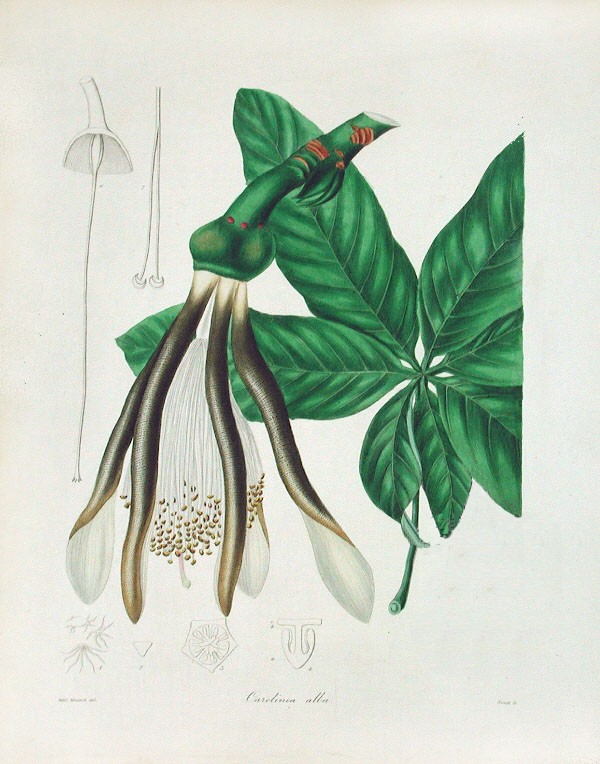
Native tree of the Atlantic Forest and Cerrado, with spectacular brush-like white flowers. EcoAgri lists it in the high stratum of the 'up to 50 years' extras. Moderate-growth pioneer; juvenile trunks bear small spines.
Götsch succession
- Götsch stage
- Secondary II
- Ecological role
- Late secondary
- Primary stratum
- High
- Strata
- High, Emergent
- Biomass class
- Mulch biomass
Environment
- Light requirement
- Full sun
- Water requirement
- Moderate
- Drought tolerance
- Moderate
Morphology
- Mature height
- 10–25 m
- Growth rate
- Fast
- Lifespan
- 30–80 years
Biomes & climate
- Atlantic Forest Native
- Cerrado Native
Köppen classes
Where it fits in a guild
Embiruçu takes the High stratum in the Secondary II phase of succession — in a guild it shares the line with species from the other strata, each harvesting light at its own height, in its own time.
Free account — and the catalog stays open, no sign-up needed.
🪴 Cultivation
A deciduous species that flowers when fully leafless (white long-stamened flowers, June–September). Can be planted in both dry and humid sites. Seedlings grow fast early on. Dry dehiscent fruits release floss-wrapped, wind-dispersed seeds (collected Sep–Nov); 10,000–15,000 seeds/kg, emergence in ~15 days, viability 4–6 months. Recommended for restoring riparian buffer zones.
📅 Phenology
Flowering months: June, July, August, September
Fruiting months: September, October, November
❓ Frequently asked questions
How tall does embiruçu grow?
At maturity, embiruçu reaches 10–25 m tall.
When does embiruçu fruit?
Fruiting of embiruçu occurs in September, October, November.
When does embiruçu flower?
Flowering of embiruçu occurs in June, July, August, September.
What stage and stratum does embiruçu occupy in a syntropic system?
In a syntropic system, embiruçu belongs to the secondary ii stage, occupying the high stratum.
Functions
Propagation
Seed
Citations
- EcoAgri — Organização de algumas espécies vegetais por tempo de vida (placentas) e estrato (Cartilha 'Liberdade e Vida com Agrofloresta') , p. 5 (primary_stratum, gotsch_stage)
- Embrapa Florestas — Embiruçu (Pseudobombax grandiflorum), Circular Técnica 155 (phenology, propagation, growth_rate, height_min_m, height_max_m, cultivation_notes)
- Apremavi — Embiruçu, endêmica da Mata Atlântica (phenology, cultivation_notes)
- Sítio da Mata — Embiruçu (Pseudobombax grandiflorum) (phenology, propagation, cultivation_notes)
External references
Continue exploring
Related plants
-
Brazilian ironwood
Libidibia ferrea
Secondary II High Fertilizer & mulchLeguminous tree occurring in Caatinga, Cerrado and Atlantic Forest. Sun-tolerant and melliferous.
-
mangaba
Hancornia speciosa
Secondary II MediumEvergreen to semi-deciduous tree 2–10 m tall, characteristic of Brazilian Cerrado and coastal tablelands. Considered one of Brazil's priority 'Plan...
-
avocado
Persea americana
Secondary II High No biomass productionLong-lived perennial fruit tree. Pasini classifies it in the high stratum of Tabela 3 and explicitly cites it among Abundance-system species (high ...
-
mango
Mangifera indica
Secondary II High No biomass productionLong-lived tropical fruit tree. Pasini lists it in the high stratum of Tabela 3 and in the '20 to 50 years' phase of Tabela 4 (high stratum). A key...
-
açaí palm
Euterpe oleracea
Secondary II High No biomass productionAmazonian native multi-stemmed palm. Pasini lists it in the high stratum of Tabela 3 and cites it explicitly among Abundance-system species. Fruit ...
-
peach palm
Bactris gasipaes
Secondary II Emergent No biomass productionAmazonian multi-stemmed palm; produces heart of palm in ~3 years and edible fruit in ~5 years. Pasini lists it in the emergent stratum of Tabela 3 ...