Plants
rice
Oryza sativa L.
Family: Poaceae · Genus: Oryza
Asian rice
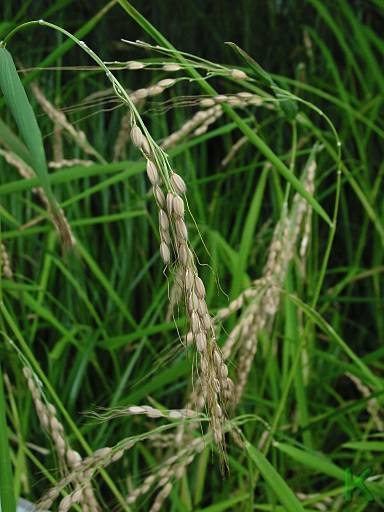
World's most-cultivated annual cereal. The Bosque de Niebla Guidebook (Consortium Design 2019) places rice as a typical Placenta I species in the high stratum, alongside lettuce and brassicas. In Brazilian agroforestry it's grown in the initial phase along tree strips, on uplands or floodplains.
Götsch succession
- Götsch stage
- Placenta I
- Ecological role
- Pioneer
- Primary stratum
- High
- Strata
- High, Medium
- Biomass class
- Mulch biomass
Environment
- Light requirement
- Full sun
- Water requirement
- High
- Drought tolerance
- Low
- Waterlogging tolerance
- High
- Soil pH range
- 6.5–7
Morphology
- Mature height
- 0.8–1.5 m
- Root system
- Fibrous
- Root depth
- Shallow
- Growth rate
- Very fast
- Lifespan
- ≤ 1 year
- Time to first harvest
- 4 months
Biomes & climate
- Amazon Suitable
- Atlantic Forest Suitable
- Cerrado Suitable
Köppen classes
- Tropical savanna with dry winter (Aw) Suitable
- Tropical monsoon (Am) Suitable
- Subtropical with dry winter (Cwa) Suitable
Where it fits in a guild
Rice takes the High stratum in the Placenta I phase of succession — in a guild it shares the line with species from the other strata, each harvesting light at its own height, in its own time.
Free account — and the catalog stays open, no sign-up needed.
🪴 Cultivation
Grows best in loose, well-drained, organic-rich soils near neutral pH (6.5–7). Lowland (flooded/irrigated) varieties are grown in standing water (~200 mm/month); upland varieties need ~750 mm over 3–4 months. Optimal day temperature 20–30 °C with nights above 15 °C.
❓ Frequently asked questions
How long until the first harvest of rice?
The first harvest of rice comes around 4 months after planting.
How tall does rice grow?
At maturity, rice reaches 0.8–1.5 m tall.
What stage and stratum does rice occupy in a syntropic system?
In a syntropic system, rice belongs to the placenta i stage, occupying the high stratum.
Functions
Propagation
Seed
Citations
- Bosque de Niebla (2019) — Syntropic Farming Guidebook, Consortium Design 2019 , p. 40 (primary_stratum, gotsch_stage)
- Feedipedia — Rice (Oryza sativa) (ph_min, ph_max, waterlogging_tolerance, water_need, cultivation_notes)
- GBIF Backbone Taxonomy — Oryza sativa (gbif_taxon_key)
External references
Continue exploring
Related plants
-
pigeon pea
Cajanus cajan
Placenta I Low Fertilizer biomass 🌱 Nitrogen fixerShort-cycle shrubby legume that fixes nitrogen, widely used in Brazilian agroforestry as green manure, early shade and food. Vigorous on poor soils.
-
sunn hemp
Crotalaria juncea
Placenta I High Fertilizer biomass 🌱 Nitrogen fixerAnnual green-manure legume, fixes up to ~450 kg N/ha, ideal for the Placenta I phase. Breaks nematode cycles and contributes large amounts of ferti...
-
velvet bean
Mucuna pruriens
Placenta I Low Fertilizer biomass 🌱 Nitrogen fixerAnnual climbing legume that fixes nitrogen (~180–220 kg N/ha) and produces dense cover biomass. Suppresses weeds, decompacts the soil, and is one o...
-
jack bean
Canavalia ensiformis
Placenta I Low Fertilizer biomass 🌱 Nitrogen fixerAnnual nitrogen-fixing legume with strong soil-decompacting and weed-suppressing ability. Explicitly cited by Pasini among Accumulation-system spec...
-
maize
Zea mays
Placenta I Emergent Mulch biomassAnnual C4 cereal — placed by Pasini in the emergent stratum of Tabela 3 and recommended for the 'up to 6 months' phase of Tabela 4. Short-cycle cov...
-
sweet potato
Ipomoea batatas
Placenta I Ground cover No biomass productionShort-cycle creeping tuber crop. Pasini lists it in the low stratum of Tabela 3. Excellent living ground cover early in the agroforestry cycle, edi...